Real-time Flood Prediction with Deep Learning
In recent years, climate change has brought frequent extreme weather such as training rainbands and localized torrential rain, increasing the risk of river flooding. For residents to evacuate quickly and for municipalities to respond effectively, it is essential to predict in real time where, when, and how deep flooding will occur as conditions change moment by moment. However, conventional inundation analysis based on physical models (numerical simulation) is computationally very expensive and lacks immediacy.
In this research, we combine dimensionality reduction techniques with deep learning (AI) to develop a surrogate model that dramatically shortens computation time while maintaining accuracy comparable to conventional physics-based simulation.
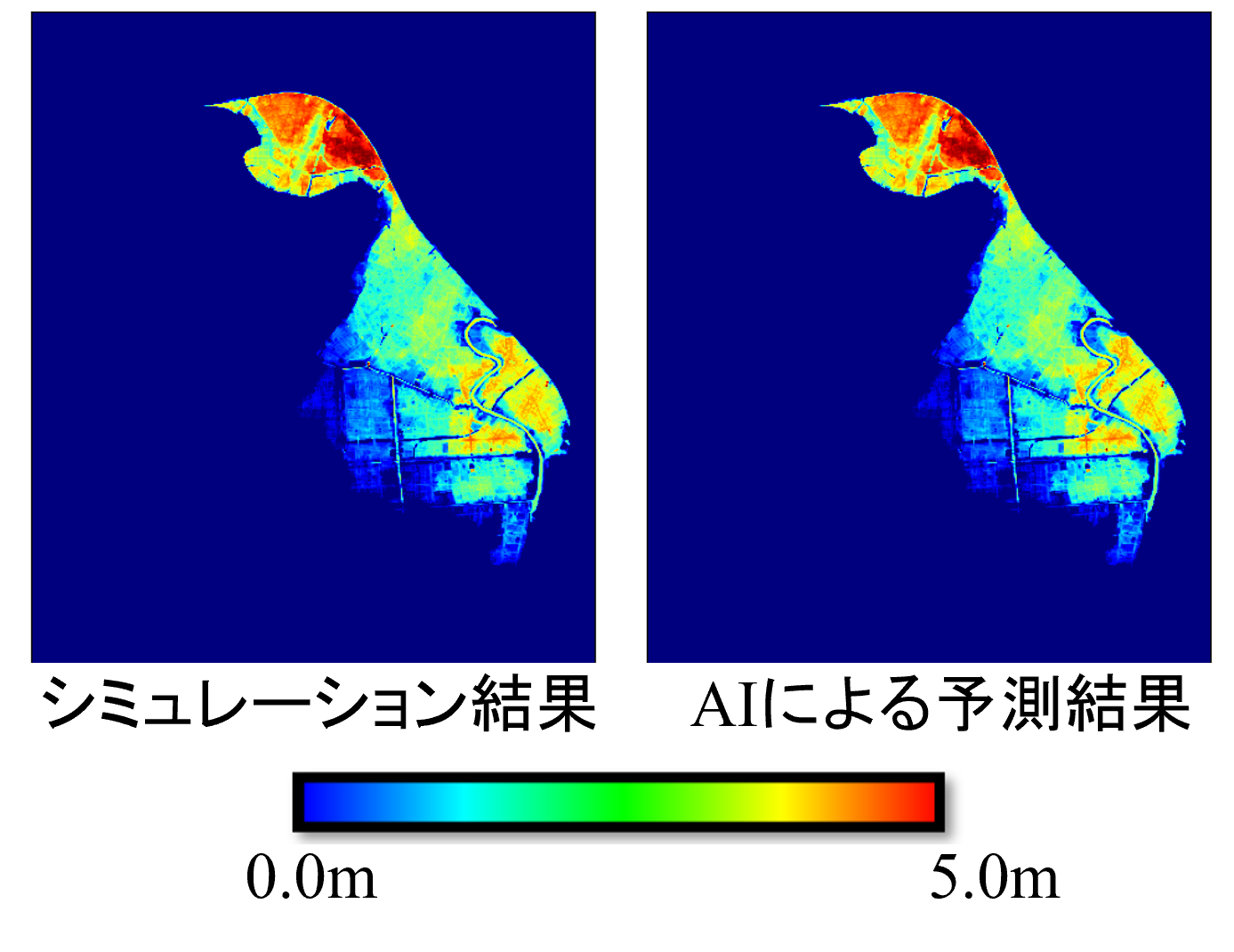
Specifically, targeting the Arakawa River basin in Tokyo, we compress enormous inundation depth data of more than 200,000 dimensions (about 220,000 grid cells) into only about 10 features using methods such as singular value decomposition (SVD), non-negative matrix factorization (NMF), and autoencoders (AE). We then use neural networks suited to time-series learning (LSTM, GRU, etc.) to predict the compressed features from river overflow depths and restore them to the original inundation maps.
Our verification so far shows that computations that took several minutes per case (more than about 200 seconds) with physical simulation can be completed in only 3-4 seconds with this method. We have also confirmed that inundation areas can be reproduced with high accuracy even in complex scenarios such as simultaneous overflow from multiple locations, not just a single breach point. In particular, the NMF-based method proved to offer an excellent balance of accuracy and computation speed.
This technology enables advanced flood prediction on an ordinary PC, without large-scale computing resources such as a supercomputer. We are now working toward applying it to wider river areas and integrating it with real-time water level prediction systems, aiming to establish it as a core technology for disaster prevention systems in society.